In short: Patricia Díaz García, a mathematics teacher, is a winner of Smile and Learn’s second AI with Educational Impact Awards (II Premios IA con Impacto Educativo) in the Secondary category. Her project, Mis aficiones y yo crecemos en proporcionalidad directa (“My hobbies and I grow in direct proportion”), is a teaching sequence for the first year of ESO (Spain’s compulsory secondary education, ages 12–13) that connects mathematics with students’ real interests. It combines Universal Design for Learning (UDL), cooperative learning and AInara, Smile and Learn’s generative AI tool. In this interview she explains how she uses AI for students with special educational needs (SEN): it saves her time and lets her create quality materials for those who need them most.
About the AI with Educational Impact Awards
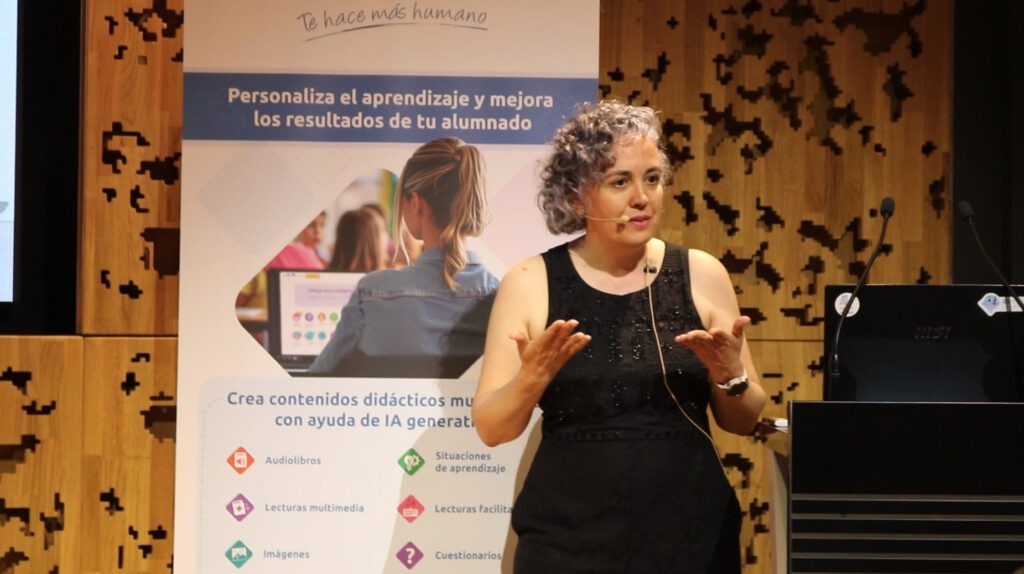
The AI with Educational Impact Awards recognise teaching projects by teachers who integrate resources generated with artificial intelligence through AInara, Smile and Learn’s tool designed by and for educators. Patricia Díaz was one of the winners of the second edition in the Secondary category. You can watch her talk at the awards ceremony in this video.
Her project is a teaching sequence for the first year of ESO based on UDL, cooperative learning and AI. It includes easy-read texts, audio, PDFs, activities and rubrics, as well as expert group meetings so that students learn and teach each other. Each student ends up with a final product personalised to their interests.
Interview with Patricia Díaz: AI for students with SEN
Why do you think using AI can improve educational projects compared with more traditional approaches?
I think it stops teachers spending time on administrative or repetitive tasks and lets them spend that time creating content that can really connect with students. In my case, it greatly reduces the time I spend writing and searching for images. That allows me to focus on creating learning situations that I think will interest my students and that let me assess their progress.
I also find its contribution to developing learning situations adapted for students with special educational needs very interesting: it saves time searching for the different assessment criteria and content for the different levels.
What specific educational problem was your project trying to solve, and how did AI help you address it?
My project aimed to adapt a learning situation to students’ different levels and interests. In this way, I sought to increase motivation and bridge the gap that appears when a student has different characteristics, such as a subject carried over from the previous year, having repeated a year, a specific learning difficulty, and so on.
What advantages has AInara offered you when designing your educational project?
It has allowed me to develop the learning situation to a level that is hard to achieve given all the other tasks teachers have: working with several groups and levels, the paperwork associated with tutoring, meetings, curriculum planning, and so on.
How has AInara helped improve inclusion, personalisation or innovation in your classroom?
It’s one of the things I like most about AInara. Easy-read versions, text-to-audio conversion and matching tasks make it possible to adapt content and assessment to different levels of students. The different translation options allow adaptation for students from different backgrounds. Because it does those tasks for me, I have more time to devote to innovation.
If other teachers wanted to replicate your initiative using AI in their teaching projects, where would you recommend they start?
AInara is a very intuitive tool. You just need an idea and to go for it. Perhaps the easiest way is to start by uploading a document we have already created and playing with the text-to-audio feature, or creating an easy-read version. That’s how I started, and it led me to keep trying the other possibilities AInara offers.
In the case of language learning, how does AInara make it easier to create and personalise content for students?
I’m a mathematics teacher and I don’t usually work on language learning. But I do find it very interesting to use AInara to create transcriptions of content in different languages (both written and audio) for students whose first language isn’t Spanish.
Regarding students with SEN, how has AInara helped remove barriers and adapt learning to their needs?
For me it’s essential. It lets me lower the level of the content, both in abstraction and in educational context, and also adapt access to it. I think students with SEN are the biggest beneficiaries of this tool. We can create high-quality materials for them, something I couldn’t do before because of the sheer amount of work I had. I always felt I wasn’t reaching them as they deserved, despite the hours I spent on them. Now I spend less time and get better results.
Conclusion
Patricia Díaz’s experience shows that AI doesn’t replace the teacher: it gives time back to support, guide and adapt, and makes it possible for every student to learn mathematics through what they are passionate about.
Want to try AInara? https://www.ainara.education/en/
