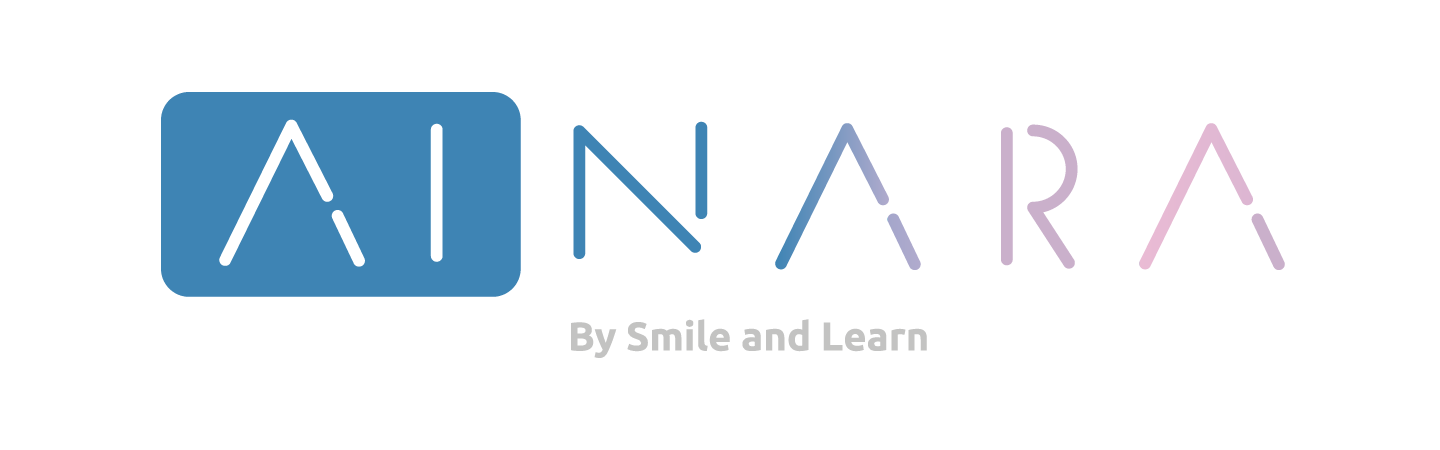
Revised Bloom’s Taxonomy pyramid showing the six levels of learning: Remember, Understand, Apply, Analyze, Evaluate, and Create
Table of contents
Quick summary
In this article we look at how to apply Bloom’s Taxonomy in its revised version by Anderson and Krathwohl (2001). We’ll also cover how applying Bloom’s Taxonomy with Artificial Intelligence (AInara) allows Primary and Secondary teachers to generate educational resources tailored to the six cognitive levels: Remember, Understand, Apply, Analyze, Evaluate, and Create. Thanks to pedagogical generative AI, teachers reduce administrative workload and automate cognitive scaffolding, designing activities aligned with the official curriculum in a matter of seconds.
Introduction
In today’s educational landscape, Bloom’s Taxonomy (in the Anderson and Krathwohl revision) is not a relic of the past: it remains the essential framework for structuring progressive, meaningful learning. However, one of the longest-standing challenges for teachers has been the time required to design varied, specific materials for each cognitive level.
AInara was created to solve this barrier — a generative Artificial Intelligence tool designed as a pedagogical productivity engine. With AInara, teachers become true classroom architects, designing coherent activities and precise cognitive scaffolding while attending to diversity, without exhausting their preparation hours.
In this guide, we’ll look at how to apply Bloom’s Taxonomy in Primary and Secondary education using AInara to boost academic performance.
Key points about Bloom’s Taxonomy and AI
- Scaffolding automation: Quickly design materials for all six levels of the taxonomy.
- Teacher cognitive offloading: Reduce time spent creating quizzes, readings, and contextualized problems.
- Attention to diversity: Adapt vocabulary complexity and task length to meet Specific Educational Support Needs (SEN).
- Curricular coherence: Ensure every generated resource is aligned with curriculum assessment criteria.
- Creative catalyst: Use AI as a springboard so students create and make their own decisions.
Summary table: Bloom’s levels and resources generated with AInara
| Cognitive Level | What does the student do? | Resource generated with AInara | Multidisciplinary example (Primary / Secondary) |
|---|---|---|---|
| 1. Remember | Retrieves basic information from memory. | Quick quizzes, flashcards, checklists. | Human body flashcards (Primary) or chemical elements (Secondary). |
| 2. Understand | Interprets and explains concepts in their own words. | Interactive readings, summaries, diagrams. | Stories with a moral (Primary) or a summary of feudalism (Secondary). |
| 3. Apply | Uses knowledge in new situations. | Step-by-step guides, templates, real-world problems. | Budgeting a birthday party (Primary) or writing a formal email (Secondary). |
| 4. Analyze | Breaks down information and identifies structures. | Error diagnostics, bias analysis. | Comparison tables (Primary) or detecting bias in the press (Secondary). |
| 5. Evaluate | Makes judgments or defends positions using criteria. | Ethical dilemmas, prototype audits. | Safety evaluation of a toy (Primary) or comparing service rates (Secondary). |
| 6. Create | Combines elements to formulate new solutions. | Story builders, project plans. | Scaffold for an original story (Primary) or a school recycling plan (Secondary). |
How to apply Bloom’s Taxonomy with AInara, step by step
1. Remember: retrieving basic information from memory
The first step is about consolidating concepts, key facts, and specific vocabulary.
- AInara’s role: Enables teacher cognitive offloading by automating the creation of active memorization exercises without eating into valuable planning time.
- Resources generated: Multiple-choice quizzes with distractors designed to catch common mistakes, interactive flashcards, and concept-matching activities.
2. Understand: interpreting and explaining ideas
Students demonstrate that they grasp the meaning of the information they’ve processed and can summarize or explain it.
- AInara’s role: Facilitates scaffolding through analogical explanations adjusted to students’ reading level.
- Resources generated: Leveled comprehension readings, visual metaphors (such as using pizza slices to explain fractions), and guided diagrams.
3. Apply: using knowledge in practical settings
Students transfer learned rules and procedures to solve real-life situations.
- AInara’s role: Designs step-by-step guides and prompts contextualized within the everyday experiences of children and teenagers.
- Resources generated: Real-world math problems (sales or budgets), simple lab guides, or formal writing templates.
4. Analyze: breaking down information and detecting patterns
Students discriminate relevant information, detect errors, and understand the structure of a problem.
- AInara’s role: Creates intentionally flawed content so students can work like “pedagogical detectives.”
- Resources generated: Problems with subtle logical errors to correct, exercises for detecting media bias, and partially completed comparison tables.
5. Evaluate: making value judgments based on criteria
Students are asked to weigh options, defend a well-argued position, and offer constructive criticism backed by objective data.
- AInara’s role: Designs ethical dilemmas and complex case studies that require motivated decision-making.
- Resources generated: Product audits (such as faulty toys), comparisons of real services, and source-reliability analyses.
6. Create: generating original ideas and solutions
At the peak of Bloom’s Taxonomy, students integrate knowledge to design original products or projects.
- AInara’s role: Doesn’t replace students’ creative thinking — it provides the initial framework or scaffold to prevent blank-page frustration.
- Resources generated: Narrative organizers for stories and phased planners for social- or ecological-impact projects.
Conclusion: the teacher as architect of learning
This integration reflects UNESCO’s guidance in its AI Competency Framework for Teachers, which reaffirms that technology should act as a mediator, never a replacement for pedagogical judgment.
Applying Bloom’s Taxonomy alongside AI tools like AInara represents a transformative shift in instructional design. Technology acts as the agile builder of teaching resources, while the teacher retains the essential role of pedagogical architect, guiding the classroom’s ethical and educational purpose.
Want to design your own resources in minutes?
Discover how AInara can help you apply Bloom’s Taxonomy in your Primary or Secondary classroom.
Frequently Asked Questions about Bloom’s Taxonomy and AI
How does Artificial Intelligence help with Bloom’s Taxonomy? Generative AI like AInara helps teachers create diverse activities for all six cognitive levels in seconds (quizzes, adapted readings, ethical dilemmas, and creative templates).
How does AInara ensure curricular coherence? Because it’s linked to official curricula, AInara automatically aligns every resource it creates with the required learning objectives and assessment criteria.
Doesn’t using AI at the “Create” level limit student creativity? No. AInara only acts as an initial structure or cognitive scaffold to prevent the initial block. From that template onward, students make the final creative decisions.
What is “cognitive offloading” in teaching? It means delegating mechanical, repetitive tasks (such as writing quizzes or flashcards) to technology, freeing up teacher time for more complex pedagogical planning.
How does AInara support attention to diversity? It lets teachers change a text’s difficulty level, length, or vocabulary type with a single click, adapting the task to each student’s needs.
Revised Bloom’s Taxonomy pyramid showing the six levels of learning: Remember, Understand, Apply, Analyze, Evaluate, and Create
The revised Bloom’s Taxonomy organizes learning into six progressive levels, from remembering facts to creating original work — a useful framework for classifying digital activities by cognitive complexity.
Sources and Authoritative References
- Anderson, L. W., & Krathwohl, D. R. (2001): A Taxonomy for Learning, Teaching, and Assessing: A Revision of Bloom’s Taxonomy of Educational Objectives. Reference documentation at the University of Burgos. UNESCO: AI Competency Framework for Teachers. Guidance on ethics and pedagogical innovation. INTEF (Spanish Ministry of Education and Vocational Training): Digital Teaching Competency Reference Framework. Educación 3.0: Proposals and teaching resources for working with Bloom’s Taxonomy.
![DIPTICO_AINARA_2024 [Recuperado]-18](https://www.ainara.education/wp-content/uploads/2024/11/DIPTICO_AINARA_2024-Recuperado-18-993x1024.png)