
At every educational stage, there are contents that can be difficult to understand. Sometimes this happens because they are abstract, because they include specific vocabulary, because they require prior knowledge, or because they are presented in a way that is too far removed from students’ experience.
Scientific concepts, historical processes, math problems, long texts, or complex ideas can become barriers if they are not explained clearly and accompanied by appropriate examples, support, and activities. That is why one of the major challenges for teachers is to transform difficult content into learning experiences that are more understandable, accessible, and meaningful.
Artificial intelligence can be an ally in this process. It can help simplify explanations, create relatable examples, divide content into steps, generate guided activities, or adapt the same topic to different levels of understanding. However, its value does not lie in making content simpler without judgment, but in helping make it clearer without losing rigor.
The key is to use educational AI as a support for designing better pathways into learning. It is not about removing difficulty, but about supporting it better.
Why Can Some Content Be Difficult to Understand?
Content can be difficult for many reasons. Sometimes the problem lies in the level of abstraction. For example, concepts such as energy, democracy, fractions, cells, or climate change are not always understood immediately because they cannot be observed or experienced directly in a simple way.
In other cases, the difficulty comes from the language. Many educational contents include technical terms that students need to learn gradually. If these terms are presented without context, they can make overall comprehension more difficult.
The way information is organized also matters. A text that is too long, an explanation with too much data, or an activity with unclear instructions can increase cognitive load and make learning more complex than necessary.
That is why transforming difficult content does not mean reducing its value, but presenting it in a more organized, gradual way that is connected to what the group already knows.
How Can AI Help Make Content Clearer?
AI can help turn a complex explanation into a more understandable version. For example, it can reformulate a text using simpler language, create a step-by-step explanation, generate everyday examples, or suggest analogies that bring the content closer to familiar situations.
It can also help organize information more effectively. A broad topic can be divided into smaller parts, with an introduction, a brief explanation, an example, a practical activity, and a reflection question. This structure helps students progress gradually.
In addition, AI can generate different formats for the same content. An explanation can be transformed into a table, an outline, a story, a dialogue, a presentation, an audio resource, or an interactive activity. This variety makes it possible to offer different ways to access information.
However, teachers must always review the result. A simple explanation should not be incorrect or incomplete. The goal is to improve comprehension, not lose accuracy.
How Can an Explanation Be Turned into a Learning Experience?
Understanding is not only about receiving information. For content to make sense, students need to connect it, manipulate it, apply it, and express it in their own words.
That is why a difficult explanation can become a more understandable experience when it is turned into an active activity. For example, an abstract concept can be worked on through a familiar situation, a challenge, a short investigation, a simulation, a comparison, or a creation.
AI can help design these types of experiences. Based on complex content, it can propose a sequence with initial questions, examples, tasks in phases, practice activities, and moments for review.
It can also help create activities in which students have to explain what they have learned in different ways: through a drawing, a presentation, an oral response, an outline, a story, or a short project. In this way, understanding becomes more visible.
How Can Difficult Content Be Adapted to Different Levels?
In the same classroom, not all students need the same type of support. Some may need a more guided explanation, others may be able to progress with greater autonomy, and others may need an extension challenge.
AI can make it easier to create different versions of the same content. For example, it can generate a version with simpler vocabulary, another with more examples, another with intermediate questions, and another with a greater level of depth.
It can also help prepare specific supports: glossaries, sentence starters, hints, graphic organizers, guiding questions, or prior activities to activate knowledge. These resources make the content more accessible without changing the learning objective.
Personalization does not mean creating disconnected materials, but offering different pathways to reach the same understanding. The teacher remains the person who decides what support the group needs and how it should be used.
What Role Does the Teacher Play in This Process?
The teacher’s role is essential. AI can generate proposals, but it does not know the classroom context, the group’s prior knowledge, or the specific difficulties that have appeared during the process.
That is why teachers act as guides, editors, and mediators. They review whether the explanation is correct, whether the level is appropriate, whether the examples are useful, and whether the activity truly helps students understand better.
They also decide when it is useful to simplify, when it is necessary to go deeper, and when it is worth maintaining a certain level of difficulty so that students learn to face intellectual challenges. AI can help open up possibilities, but pedagogical judgment continues to guide the way.
How Can AInara Help Create More Understandable Experiences?
AInara makes it possible to transform complex content into clearer, more varied, and more adapted educational resources. From a safe and guided approach, it helps teachers generate explanations, activities, quizzes, audio resources, stories, or learning situations adjusted to different levels and needs.
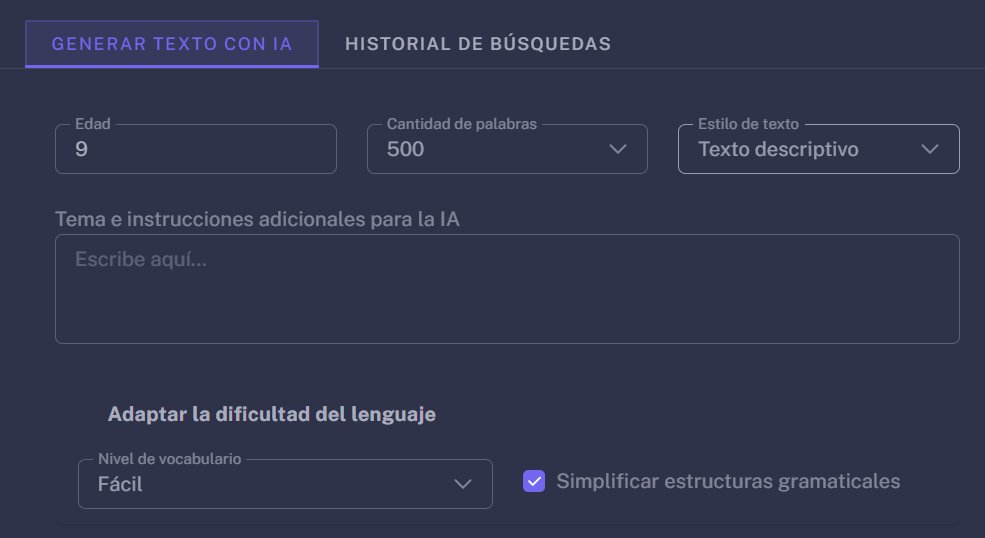
With AInara, difficult content can become a more accessible sequence, with examples, intermediate phases, comprehension questions, and practice proposals. In addition, the easy reading tool makes it possible to adapt texts so that they are clearer, more organized, and easier to understand, while maintaining essential information and reducing possible access barriers. It also offers the possibility of adjusting language by level, which helps present the same content with different degrees of difficulty according to students’ needs. In this way, teachers can create more guided, simpler, or more advanced versions, without losing sight of the learning objective or the rigor of the content.
Its value lies in helping design experiences with pedagogical intention. It is not only about creating more materials, but about making learning more understandable, personalized, and connected to the reality of the classroom.
In Summary
Transforming difficult content into more understandable experiences does not mean eliminating difficulty, but supporting it better. To achieve this, it is important to organize information, use clear examples, offer support, propose active activities, and adapt resources to different learning levels.
AI can help simplify, structure, adapt, and transform content, but it always needs teacher review. Teacher judgment ensures that materials are rigorous, appropriate, and useful.
With AInara, artificial intelligence becomes an ally for creating clearer, more accessible, and more personalized resources, helping students better understand complex content and progress with more confidence in their learning.
![DIPTICO_AINARA_2024 [Recuperado]-18](https://www.ainara.education/wp-content/uploads/2024/11/DIPTICO_AINARA_2024-Recuperado-18-993x1024.png)