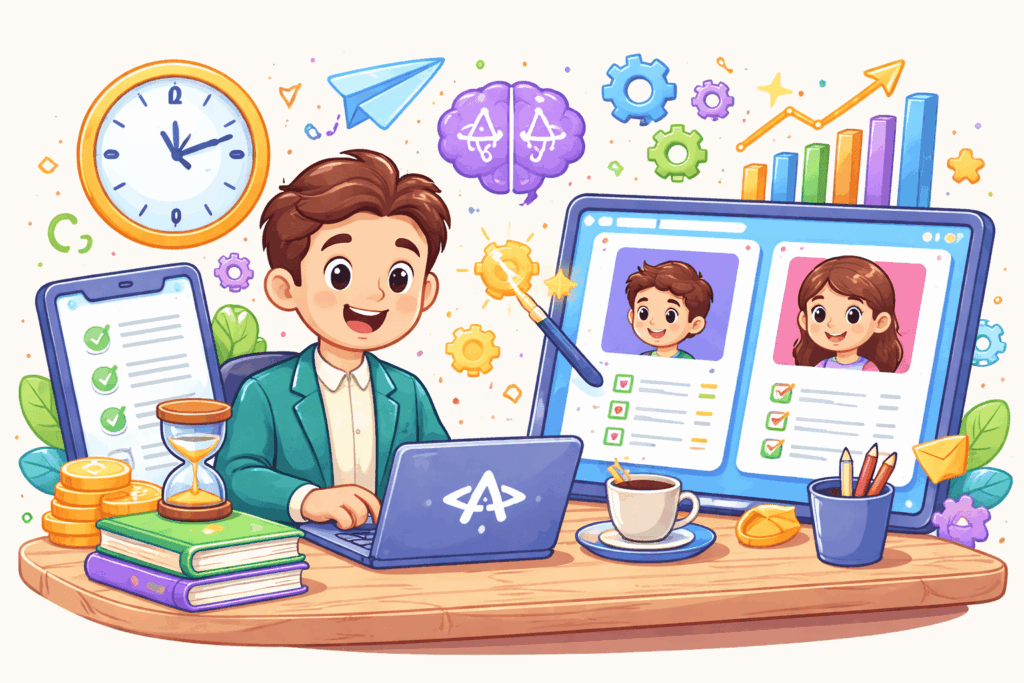
In an educational landscape that is increasingly diverse, demanding, and fast-changing, AI offers practical solutions to save time, personalize learning, and improve instructional quality—without teachers losing control or professional judgment.
When applied well, AI strengthens teachers’ work, allowing them to focus on what matters most: supporting, motivating, and teaching students.
The challenge for today’s teachers: more tasks, less time
Teachers in Spain currently face multiple daily challenges:
- Supporting classroom diversity, with large groups and increasingly heterogeneous students in pace, interests, and learning needs.
- Designing activities adapted to different levels, ensuring no student is left behind and everyone can progress from their starting point.
- Carrying out ongoing, personalized assessment that goes beyond traditional tests and helps track real learning progress.
- Taking on a growing administrative workload, which reduces time for instructional planning and direct student support.
- Sustaining continuous instructional innovation, avoiding falling behind rapid technological advances that students already use in their everyday live.
This is where educational AI, used correctly, can make a difference: automating repetitive tasks and providing instructional support—without replacing teacher decision-making.
AI for teachers: real classroom benefits
Artificial Intelligence applied to teaching makes it possible to:
1. Plan better, in less time
AI can help generate:
- Curriculum-aligned learning sequences.
- Differentiated activity suggestions.
- Ideas for projects, debates, or cooperative work.
This frees up time for instructional reflection and direct support for students.
2. Personalize learning
With AI tools built with an instructional lens, such as AInara, teachers can:
- Adapt content to different paces and levels.
- Quickly propose reinforcement activities or extra practice.
- Better support the classroom’s linguistic diversity.
Personalized learning—which has traditionally meant extra work for teachers—can become, with AI support, a viable and sustainable instructional practice rather than an additional administrative burden.
3. Support formative assessment
AI can assist with:
- Creating assessment rubrics.
- Generating self-assessment quizzes or reflective questions.
- Analyzing evidence of learning.
Always with the teacher as the final decision-maker in the process.
AInara: educational AI designed for teachers
In this context, AInara emerges as an Artificial Intelligence tool designed specifically for teachers, with an instructional, ethical, and practical focus.
Unlike generic tools, AInara understands the educational context and supports teachers day to day, helping them:
- Design activities aligned with lesson planning.
- Generate resources adapted to classroom diversity.
- Save time in lesson preparation.
- Maintain instructional control and professional judgment.
AInara does not replace teacher decisions; it provides tools to create resources quickly and easily, always respecting the teacher’s instructional judgment.
AI with instructional judgment: the teacher stays at the center
One of the biggest fears about AI is losing control. However, educational tools like AInara show that the key is the approach:
- It does not replace teacher expertise.
- It does not assess without oversight.
- It does not teach without instructional intent.
Teachers remain the ones who:
- Define objectives.
- Adjust suggestions.
- Evaluate results.
- Support students.
Preparing students for the future starts by supporting teachers
For students to learn to use AI critically and responsibly, the first step is for teachers to feel comfortable, confident, and supported in their professional use of it. Understanding AI from an instructional perspective makes it possible to anticipate how students will use it and guide them so it becomes an educational tool—not just a tech resource.
AInara contributes to this goal by offering AI that is:
- Accessible: Its intuitive, user-friendly interface allows teachers to create educational content and activities quickly and easily, without advanced technical knowledge. This makes it easier to adapt resources to the classroom’s pace and level, optimizing time spent on lesson preparation.
- Understandable: The AI is designed so teachers can clearly understand how it works, how it generates content, and how it can be adjusted to different instructional goals. This deeper understanding is essential to anticipate how students will use it and to teach them to interact with AI critically and responsibly.
- Aligned with real classroom needs: AInara enables teachers to create resources that reflect students’ interests, abilities, and diversity. Its tools are designed so each activity has real instructional value, supporting personalized learning without overloading teachers with repetitive tasks.
- Designed to improve teaching practice: It supports experimentation, instructional innovation, and the ethical, critical integration of AI—ensuring that technology strengthens professional judgment rather than replacing it.
AInara’s value is not only in automating tasks, but in empowering teachers to use AI strategically, instructionally, and thoughtfully.
Artificial Intelligence is transforming teaching, but the real change is not in the technology—it’s in how it’s used. When AI is put in service of teachers, it becomes a powerful tool to innovate, personalize learning, and improve education.
Discover how AInara can help you in your teaching practice.
![DIPTICO_AINARA_2024 [Recuperado]-18](https://www.ainara.education/wp-content/uploads/2024/11/DIPTICO_AINARA_2024-Recuperado-18-993x1024.png)