Director of the ERIA Chair — Employability and Responsibility in AI — UAM–Founderz–Microsoft
The incorporation of artificial intelligence into initial teacher training is significantly transforming the way future teachers design, assess, and personalize learning. These tools not only make it possible to create educational resources more quickly, but also open the door to more flexible, inclusive methodologies adapted to student diversity. However, this progress also raises important challenges related to the responsible use of technology and learning assessment.
In this context, university education plays a key role in ensuring that future teachers not only use artificial intelligence, but also learn to integrate it with pedagogical purpose, critical judgment, and ethical responsibility. Reflection on algorithmic bias, the reliability of information, and transparency in the use of AI thus becomes an essential element of the training process.
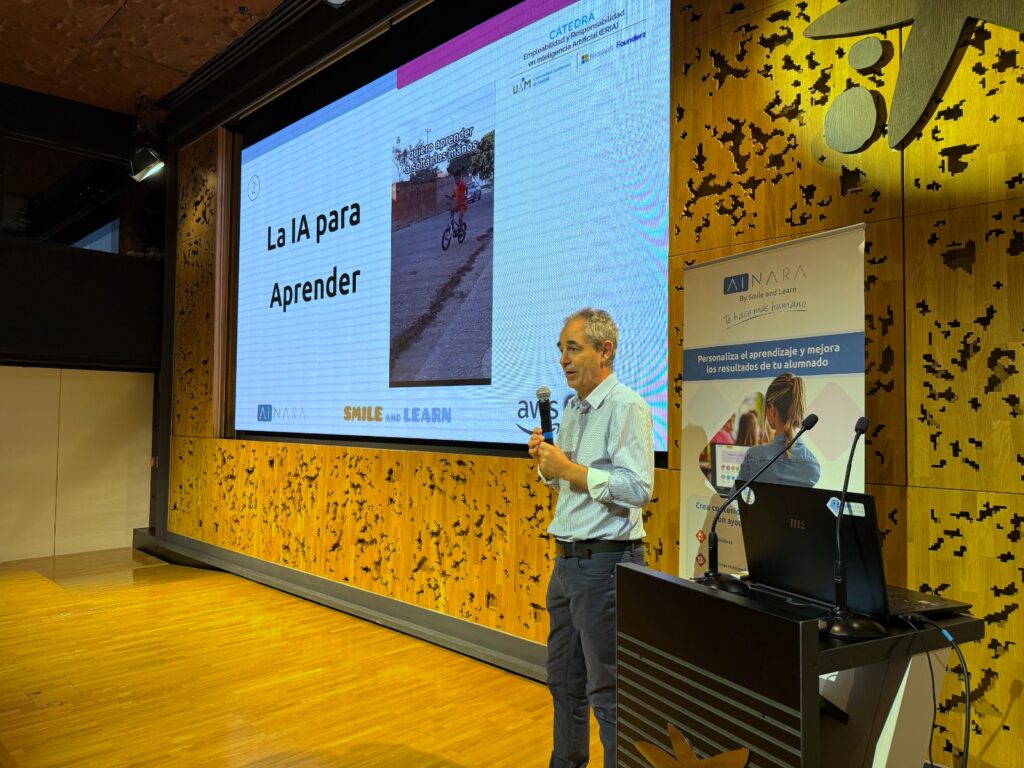
In this interview, Melchor Gómez, Director of the ERIA Chair — Employability and Responsibility in AI — UAM–Founderz–Microsoft, shares his experience working with students at the Autonomous University of Madrid and using AInara as an educational tool. Through his experience, he analyzes how artificial intelligence can contribute to the development of digital teaching competence, foster methodological innovation, and promote the pedagogical integration of AI based on critical reflection and meaningful learning.
1. Briefly summarize the project being carried out with your students using AInara.
As part of our initial training in digital competencies with future Early Childhood and Elementary Education teachers at the Autonomous University of Madrid, we incorporate AInara as another tool within the topic of responsible AI use. Students receive initial training integrated into the context of the course, and content creation experiences for the classroom are designed. The results and processes are then assessed, followed by critical reflection and opportunities to improve learning.
2. What teaching competencies do you think your students have developed by designing educational resources with AInara?
By designing resources with this AI tool, students do not simply learn how to “type”; they develop key dimensions of Digital Teaching Competence:
They learn how to use AInara, which requires them to be extremely clear about their pedagogical objectives. This involves supported prompt engineering.
They develop the ability to determine whether the generated material is high quality, appropriate for the age of their future students, and aligned with the curriculum. This involves evaluative judgment.
They learn to create multiple versions of the same resource in order to address diversity. This supports personalization and Universal Design for Learning.
3. How were the projects designed so that the use of AInara was not merely instrumental, but pedagogically grounded?
To prevent AInara from becoming just a shortcut, we designed the projects using frameworks such as TPACK — Technological Pedagogical Content Knowledge. We do not start with the tool, but with the challenge: the “why” before the “how.”
Students are asked to justify what value AI adds that a traditional method does not. If AI simply does the same thing faster, there is no real innovation.
We also integrate AI into Flipped Classroom or Problem-Based Learning processes, where the tool acts as “scaffolding” that allows students to reach higher cognitive levels — creating and evaluating — instead of remaining at the level of mere repetition.
4. To what extent is AInara a flexible tool capable of adapting to different educational settings and teaching uses?
AInara is undoubtedly a flexible tool because it supports various formats.
It can transform a complex text into a podcast, a visual outline, or a set of practical exercises in seconds.
In addition, we can use it as a personalization system that generates content and processes adapted to each student’s pace, which is vital in classrooms with high student-teacher ratios where teachers cannot attend to everything.
It also facilitates inclusion by simplifying language for students with comprehension difficulties or instantly translating materials, making content more accessible.
5. How do you work with your students on critical reflection about the use of artificial intelligence in the classroom, especially in relation to ethics, bias, and the reliability of information?
This is undoubtedly the key element, because AI is easy to use from a technical point of view, but we cannot use it blindly.
We carry out argumentative activities, such as asking AI to generate an argument and then asking students to find three sources that contradict or qualify it.
We also analyze bias, sometimes using AI-generated images, investigating how they reproduce gender or racial stereotypes and discussing how this affects values education.
Above all, we focus on transparency and supervision. It should always be clearly stated which parts were created with AI and how that information was verified or cross-checked.
6. After this experience, what recommendations would you give to other university professors who want to integrate tools like AInara into initial teacher training?
Giving recommendations always carries the risk of losing sight of context, because every reality is different. Even so, I can share some impressions from our own experience.
In such a new field, teachers and students often learn side by side, and we need to lose the fear of “not knowing” more than our students.
We need to design a new assessment system from scratch. Tools like AInara can generate perfect assignments, but the problem is not AI; it is an assessment system based on assignments. We need to move from assessing the “final product” to assessing the creation process and the student’s critical reflection.
Finally, I would emphasize that AInara facilitates experimentation and makes it possible to create testing scenarios where mistakes should not be penalized, but should instead help identify where the weaknesses are. These tools can be an excellent “laboratory” for learning without fear of making mistakes.
![DIPTICO_AINARA_2024 [Recuperado]-18](https://www.ainara.education/wp-content/uploads/2024/11/DIPTICO_AINARA_2024-Recuperado-18-993x1024.png)