Talking about inclusion in education is not just about recognizing that every student learns in a different way. It means designing experiences in which everyone can participate, feel part of the group, and develop their potential through their own abilities.
True inclusion does not happen when students are expected to adapt to an activity that has already been designed. It happens when teachers adapt the learning experience so that every child can take part in a meaningful way. In this process, teacher creativity, empathy, and technology can become powerful allies.
When artificial intelligence is used with a clear pedagogical purpose, it can help create materials that are more accessible, personalized, and connected to classroom reality. It does not replace the teacher’s perspective, but it can expand the possibilities for responding more effectively to diversity.
Inclusion and Meaningful Learning
Inclusion has great potential to transform the educational experience. It is not only about removing physical barriers or adapting materials, but also about changing the way we look at students.
Each student comes to the classroom with different abilities, needs, learning rhythms, and ways of engaging with learning. That is why an inclusive approach must allow for different ways to participate, understand, express ideas, and move forward.
This approach helps diversity stop being seen as a challenge and start being understood as an opportunity to learn together. When the classroom becomes a space where everyone has a role, empathy stops being an abstract word and becomes a concrete action.
The Role of AI in Designing Inclusive Experiences
Generative artificial intelligence can bring great value to this process. Tools like AInara make it possible to create resources adapted to different levels, turn ideas into stories, generate visual supports, prepare challenges, organize materials, and provide different ways to access content.
This is especially useful when teachers want to design more personalized experiences without losing sight of the pedagogical goal. AI can help turn an initial idea into a more complete, accessible, and motivating proposal.
It also makes it possible to adjust language, create visual materials, generate cooperative dynamics, and offer supports so that more students can actively participate in the activity.
Jacob Sancho’s Project: La Liga de los Invisibles
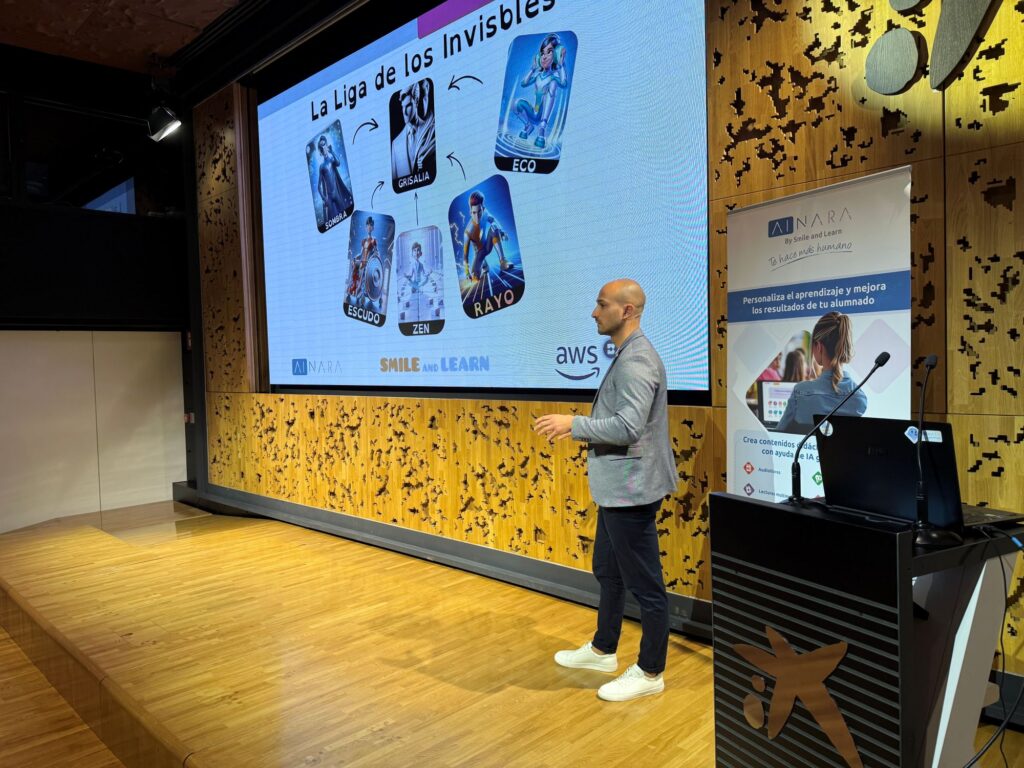
A clear example is the project presented by Jacob Sancho, a Physical Education teacher in Las Rozas de Guardo, Palencia, and winner of the special mention for the Special Educational Needs project at the 2nd AI with Educational Impact Awards.
His proposal, titled La Liga de los Invisibles, is based on a very meaningful idea: turning disability and diverse abilities into a superpower. To do this, Jacob created a narrative in which a group of heroes had to face Grisalia, a gray society that represents exclusion, monotony, and the barriers that often go unnoticed.
The project was not only designed to work on Physical Education content, but also to help students experience inclusion firsthand. Through play, storytelling, and challenges, children were able to put themselves in the place of people with different abilities and better understand the barriers they face in their daily lives.
How AInara Made the Experience Possible
AInara was a key ally in the development of the project. Jacob used the tool to transform his ideas into a story, organize materials, and create accessible resources for his students.
AI acted as a narrator, helping turn the project into a meaningful adventure. It also worked as a pedagogical translator by supporting the creation of pictograms, challenges, messages, and adapted stories. In addition, it helped create a visual identity for the characters through superhero trading cards.
These characters represented different realities: visual impairment, hearing impairment, physical and motor disabilities, hemiparesis, and autism spectrum disorder. Each hero had a power connected to their own way of being in the world, showing students that a difficulty can also become a different way of contributing to the group.
In this way, AInara did not only help generate materials. It made it possible to build a more emotional, accessible, and meaningful experience.
From Physical Education to a Commitment to Life
One of the most interesting aspects of the project is that it begins in the area of Physical Education. As Jacob explains, the body does not lie: if you cannot see, you cannot see; if you cannot reach, you cannot reach; if you cannot climb a step, that barrier becomes visible.
That is why Physical Education becomes an especially valuable space for working on inclusion. Through movement, play, and cooperation, students can experience situations that help them look at their surroundings in a different way.
In the final mission of the project, called Ciudad Invisible, students had to identify real barriers in their environment. Learning moved beyond the classroom and connected with everyday life. When a child notices a step in their neighborhood and thinks that one of the heroes would not be able to get past it, inclusion stops being theory and becomes awareness.
And precisely to understand how this initiative was born and the real impact it is having on students, it is worth listening to Jacob explain the project in his own words in the following talk:
Technology at the Service of a More Human Education
This project shows how artificial intelligence can serve a more human kind of education. AInara does not replace the teacher’s sensitivity or the relationship with students. Instead, it helps shape a pedagogical idea and turn it into a richer, more accessible, and more motivating experience.
Inclusion requires time, intention, and creativity. It also requires tools that help teachers design proposals adapted to the reality of each classroom. In this sense, AI can be a great ally for creating personalized materials, reducing barriers, and offering new forms of participation.
La Liga de los Invisibles reminds us that true inclusion is not about asking students to fit into an activity, but about transforming the activity so that everyone can be part of it.
Because when technology is used with purpose, it does not distance teachers from their students: it helps them see more clearly what may have gone unnoticed before.
To explore this project in depth and discover the selection highlighted by the jury of the 2nd AI with Educational Impact Awards, access all the selected projects here:
![DIPTICO_AINARA_2024 [Recuperado]-18](https://www.ainara.education/wp-content/uploads/2024/11/DIPTICO_AINARA_2024-Recuperado-18-993x1024.png)