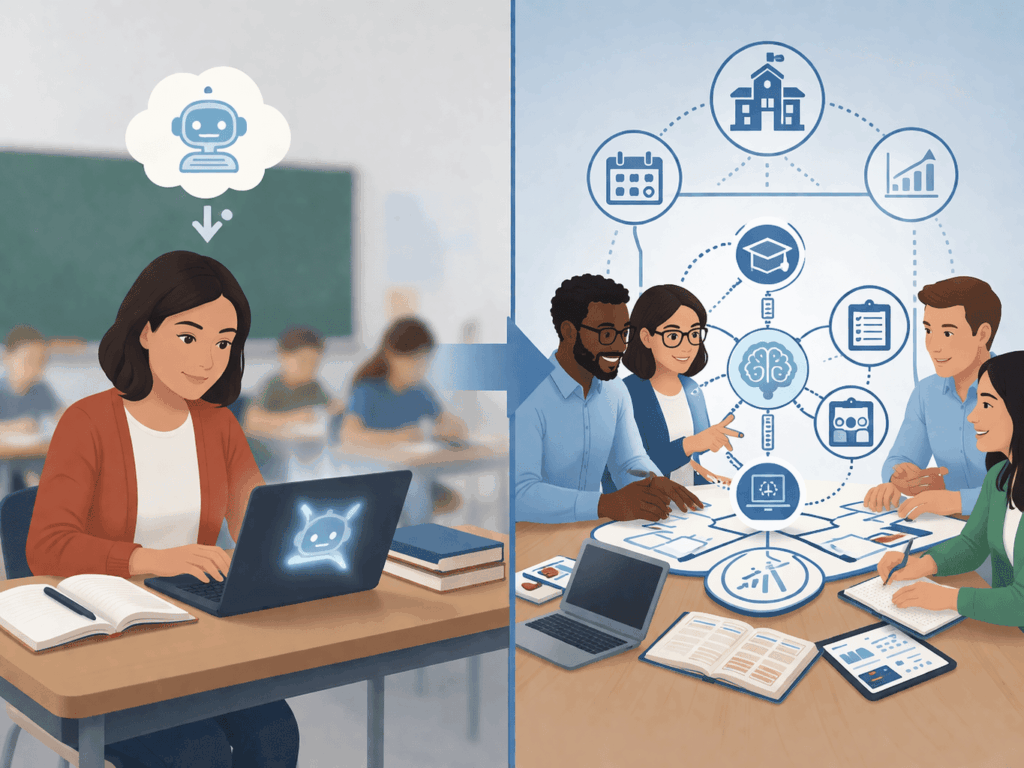
Artificial intelligence is already present in many educational settings. It’s used to create activities, summarize texts, adapt materials, or generate assessments in less time. However, using AI is not the same as having an AI strategy in education.
That difference marks the real leap forward. “Using AI” usually means applying individual tools to solve specific tasks. “Having an AI strategy,” on the other hand, involves integrating that technology with a clear purpose, shared goals, and defined pedagogical criteria. It’s not just about adding a new tool, but about deciding what role AI will play in the school or in teaching practice.
From Occasional Use to a Shared Vision
Moving from isolated actions to a common vision
In many cases, AI enters the classroom spontaneously. One teacher uses it to prepare a worksheet, another to translate a text, and another to generate exam questions. These are useful, but isolated uses.
The problem arises when everyone moves forward on their own. This leads to scattered tools, inconsistent results, concerns about privacy, lack of coherence, and limited ability to share or scale good practices.
That’s why the first step toward an AI strategy is building a shared vision. Schools need to ask what they want to achieve with AI and how it can help improve learning, personalization, inclusion, or teaching efficiency.
Changing the question: from “what tool should I use?” to “what need do I want to solve?”
An AI strategy doesn’t begin with choosing platforms, but with identifying real needs. The key question is not “what AI can we use?” but “what do we need it for?”
This shift is essential. AI makes sense when it responds to specific goals, such as reducing administrative workload and preparation time, personalizing content based on levels and learning pace, supporting diverse learners, generating resources in different formats, supporting bilingual or multilingual contexts, or improving assessment and feedback.
When AI is connected to real needs within the school, it stops being a collection of experiments and becomes a tool for transformation.
Putting pedagogy above technology
Having an AI strategy in education is not about automating for the sake of automation. It’s about putting technology at the service of pedagogical intent.
This means that any resource generated with AI must meet clear criteria: age appropriateness, curricular alignment, instructional quality, accessibility, and teacher oversight. Speed cannot replace pedagogical judgment.
In this sense, a well-designed AI strategy reinforces the teacher’s role. AI helps save time and expand possibilities, but teachers are the ones who validate, adapt, contextualize, and make decisions.
From Experimentation to Real Integration
Thinking in processes, not just isolated uses
Another key step is to stop seeing AI as something used “from time to time” and start integrating it into concrete educational processes. For example, in designing learning activities and experiences, adapting materials for different student profiles, creating assessments, producing accessible resources, or generating content for different languages or proficiency levels.
When AI is embedded in everyday processes, its use becomes more coherent, sustainable, and valuable for the school.
Establishing shared criteria for use
For a true strategy to exist, AI use must be supported by common agreements. It’s important to define the criteria that will guide its use: pedagogical quality, security, privacy, human review, contextual relevance, and real usefulness for teachers and students.
This provides clarity and trust. It also prevents implementation from depending solely on individual initiative or temporary enthusiasm.
AInara: AI Designed for Education
On this journey, having solutions specifically designed for the educational field can make it much easier to move from occasional use to a real strategy. AInara, Smile and Learn’s AI, is built precisely with this approach in mind.
Its value lies not only in generating content, but in doing so within an educational framework. It enables the creation of useful classroom resources in multiple formats with personalization options—especially important when a school wants to integrate AI coherently rather than as a set of disconnected tools.
Beyond the technology itself, what matters is that the tool helps teachers work more efficiently, with greater control and stronger pedagogical alignment. That’s where a solution like AInara can help turn AI use into a true educational strategy.
The Real Change Is Strategic
The question is not whether a school uses AI or not. The question is whether it is being used in isolation or incorporated with a clear vision.
Moving from “using AI” to “having an AI strategy” means defining objectives, identifying needs, establishing pedagogical criteria, and turning technology into an ally in the service of learning. That’s where AI stops being a novelty and begins to generate real value in education.
![DIPTICO_AINARA_2024 [Recuperado]-18](https://www.ainara.education/wp-content/uploads/2024/11/DIPTICO_AINARA_2024-Recuperado-18-993x1024.png)