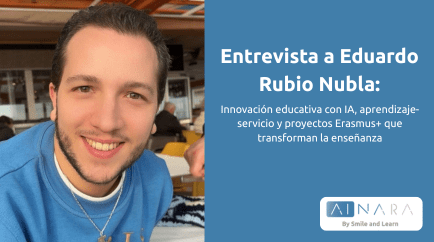
With a strong international track record and an innovative vision for education, Eduardo Rubio blends creativity, technology, and social commitment to transform teaching and learning. An EdTech Ambassador and an expert Erasmus+ evaluator, he has led more than 10 international projects and shared his active learning methodologies at venues such as BETT London, SIMO, and conferences in France, Italy, and Ireland.
His musical training in Paris and Barcelona, together with his command of digital tools and educational gamification, has enabled him to design learning experiences that connect creativity, inclusion, and technology. His purpose is clear: to inspire students and educators through educational projects that leave a lasting impact.
In this interview, we talk with Eduardo about his project “Inclusive Water Voices: From the Spring to the Future,” developed within the framework of an eTwinning and Erasmus+ project. We explore how he integrates artificial intelligence, intergenerational storytelling, and service-learning to promote inclusion, historical memory, and students’ critical thinking—turning technology into a tool in the service of social impact and educational innovation.
1. What was the main goal of the workshop “Inclusive Water Voices: From the Spring to the Future”?
The primary goal was to create an intergenerational connection using storytelling as a bridge. We wanted 10th-grade students to capture older adults’ historical memories about water use and transform those analog memories into accessible digital resources. Essentially, it’s about turning young people into “amplifiers” of elders’ wisdom—using technology to preserve cultural heritage and foster empathy.
https://vm.tiktok.com/ZNRyDa1kN/
https://vm.tiktok.com/ZNRyDa1kN
2. Why did you decide to include artificial intelligence in this project, using AInara?
We chose AInara because it’s an all-in-one tool built by and for educators. In a service-learning project, time is everything; AInara helps us streamline the creation of texts, audio, and activities without losing academic rigor. It also offered three essential pillars:
• Versatility: The ability to generate everything from historical images to audiobooks on a single platform.
• Accessibility: The option to adjust speech speed and language complexity so residents could enjoy the content without cognitive barriers.
• Safety: Ensuring student data privacy in a secure, supervised environment.
3. How did you structure the experience so your students participated actively?
The experience was designed in five dynamic phases that guide students from active listening to technical production:
1. Connection: Using an “icebreaker question” to build a human connection.
2. Visual Memory: Creating comparison visuals (past vs. present) using AInara’s image generator.
3. Audio Storytelling: Turning anecdotes into audiobooks with calm background music, validating the text with the resident in real time.
4. Gamification: Creating a customized word search with key concepts from the conversation to stimulate cognitive engagement for the older adult.
5. Legacy: Final reflection and showcasing the work, closing the service-learning cycle.
4. What skills do you think students developed through this activity?
Students developed a hybrid skill set:
• Digital Competency: Advanced use of generative AI to create multi-format content.
• Media Literacy: The ability to edit and supervise AI outputs, applying their own human judgment.
• Social-Emotional Skills: Empathy, active listening, and intergenerational respect.
• Curricular Adaptation: They learned to create cognitively accessible materials (large fonts, simple language), understanding the needs of different communities.
5. How does using AInara’s AI support students’ critical and reflective thinking about social issues?
AI works like a mirror of social change. When students ask AInara to generate an image of “women washing clothes in the river” and compare it with today’s instant access to tap water, they reflect on progress, modern loneliness, and sustainability. AInara doesn’t replace thinking—it sparks it by making it easier to create materials that invite comparison and ethical debate about how technology and access to resources have changed our lives.
6. What would you recommend to other teachers who want to integrate tools like AInara into their teaching?
My main recommendation is to let go of fear and focus on the learning purpose.
• Start simple: Use AInara’s predefined menus and shortcuts to save prep time.
• Encourage co-creation: Students shouldn’t just consume—they should create, adjusting voices, languages, and complexity levels.
• Prioritize human judgment: Remember that AI suggests, but the teacher (and the student) decides and supervises the final result to ensure quality and rigor.
If you also want to launch educational projects with real-world impact, integrate AI safely, and foster creativity, inclusion, and critical thinking in your students, now is the time to take the next step. Get inspired by experiences like “Inclusive Water Voices” and transform your classroom into a space for innovation with purpose. Try AInara in your classroom and turn every project into an opportunity to learn, create, and make a lasting impact.
![DIPTICO_AINARA_2024 [Recuperado]-18](https://www.ainara.education/wp-content/uploads/2024/11/DIPTICO_AINARA_2024-Recuperado-18-993x1024.png)