In an education system that is becoming increasingly diverse, supporting learner diversity is an essential teaching practice to ensure that all students have equal opportunities to learn and thrive. Approaches such as Universal Design for Learning (UDL) have shown us that by adapting content, methods, and assessment, we can better address individual differences in learning pace, style, and ability.
Artificial Intelligence (AI) is becoming a transformative tool for bringing these strategies into day-to-day practice, making it possible to provide more personalized, accessible, and flexible support for each student.
1. Easier, adapted understanding
One of the most common barriers for many students—especially those with reading difficulties, dyslexia, or visual impairments—is accessing complex written content. With AI technologies like those integrated into AInara, it is possible to:
- Adapt vocabulary level and simplify texts to make key concepts easier to understand.
- Generate narrated versions of content, with control over speed and intonation, which supports students who learn better by listening than by reading.
- Automatically highlight paragraphs as the text is narrated, helping students maintain attention and connect what they see in writing with what they hear.
These features make educational resources more accessible and better aligned with each student’s learning pace.
2. Multimodality in service of diversity
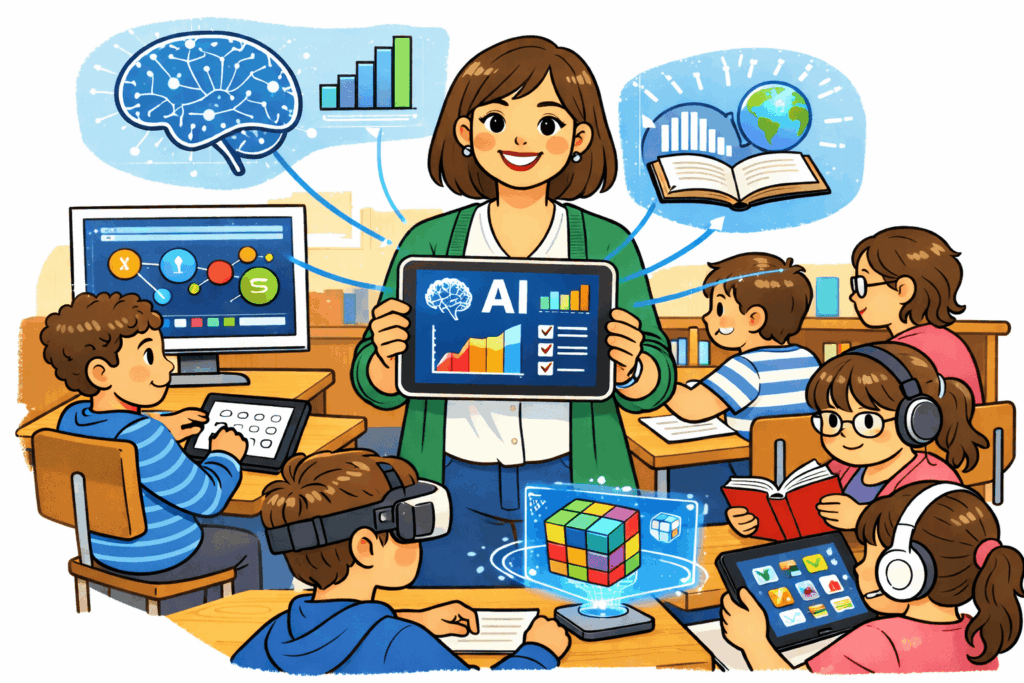
AI enables the multimodal creation of learning materials: from a single piece of content—such as an explanatory text—it is possible to produce, at the same time:
- adapted texts,
- audio,
- AI-generated images in different visual styles.
This makes it easier for students with different learning styles—visual or auditory—to access the same content in different, complementary ways.
3. Personalization based on learning profiles
Beyond formats, AI also makes it possible to personalize content to each student’s individual needs. Some of the options and possibilities AInara offers include:
- Combining simplified texts with audio and visual resources adapted to different learning styles.
- Incorporating teacher-created visuals to contextualize content for a specific group.
- Creating assessment activities such as quizzes supported by images, designed to reinforce understanding without adding extra barriers, while adjusting both the format and the presentation style.
4. Toward a more inclusive education
AI is not meant to replace teachers’ work, but to expand their ability to create richer, more accessible, and better-adapted resources without multiplying workload. By automating tasks such as generating materials, synchronized narration, or multimodal conversion, AInara makes it possible to devote more time to:
- observing, understanding, and supporting each student,
- making instructional decisions centered on students’ real needs,
- building truly inclusive classrooms that respect different learning paces and styles.
AI applied to education—especially in platforms designed with strong pedagogical criteria like AInara—offers a promising path to improve support for learner diversity: from adapting content to creating learning experiences that are more accessible, meaningful, and personalized for everyone.
![DIPTICO_AINARA_2024 [Recuperado]-18](https://www.ainara.education/wp-content/uploads/2024/11/DIPTICO_AINARA_2024-Recuperado-18-993x1024.png)