Educational artificial intelligence is transforming how classroom resources are created, adapted, and used. This transformation isn’t just about adding technology—it’s about using it with a clear pedagogical approach that improves learning.
In this context, AInara, the AI tool created by Smile and Learn, emerges as a solution specifically designed for education. Its goal is clear: to help teachers create personalized, accessible, high-quality content without losing pedagogical control.
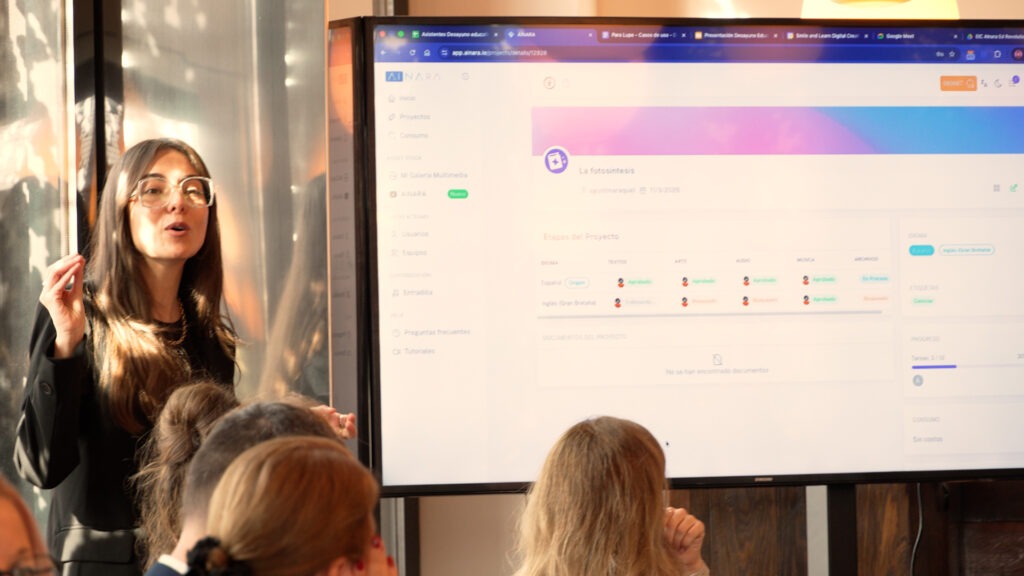
To understand how to effectively apply AI in the classroom, we look at the key insights shared by Agustina Merizzi, an educational consultant at Smile and Learn, who presents AInara as a bridge between educational theory and practice.
Practical Benefits of AInara in the Classroom
One of the main challenges teachers face is student diversity: different learning paces, levels, and needs coexist in the same classroom. In this context, artificial intelligence becomes a key ally.
As Agustina explains, AInara allows teachers to quickly and efficiently personalize educational materials, adapting them to different student levels and profiles.
Its main advantages include:
- Time savings for teachers
It automates the creation of materials, allowing teachers to focus on supporting student learning. - Addressing diverse learning needs
Content can be adapted to different levels or simplified for students with specific needs. - Accessibility
The tool has been developed with inclusive criteria, in collaboration with organizations such as ONCE. - Multiformat and multimodal resources
Teachers can generate readings, quizzes, audiobooks, or interactive materials from a single platform. - Assessment with immediate feedback
The generated materials provide real-time insights into student progress.
All of this supports a personalized learning approach, which is increasingly essential in today’s classrooms.
Real Classroom Use Cases
Adapting content for diverse learners
Starting from a base text, teachers can generate simplified versions with clearer structures and more accessible vocabulary. This allows all students to work on the same content, adapted to their level.
Supporting international students
AInara can adapt texts to the Common European Framework of Reference for Languages (CEFR), making it easier for students with different language levels to learn—especially in bilingual settings or classrooms with migrant students.
Creating audiobooks
From any document, teachers can generate audiobooks with different voices and speeds. This is especially useful for students with reading difficulties or to strengthen listening comprehension.
Enhancing existing materials
Teachers can upload their own content and transform it into more engaging resources by adding visuals, audio, or interactive activities.
The Key Role of the Teacher: Filtering and Guiding
One of the main messages is that AI does not replace the teacher.
Agustina emphasizes that while AInara greatly simplifies content creation, pedagogical judgment remains essential.
Teachers must review, adapt, and contextualize the generated materials, avoiding information overload and ensuring quality. AI suggests—but the teacher decides.
An AI Tool Designed Specifically for Education
Unlike general-purpose tools, AInara has been created by Smile and Learn with an exclusively educational focus.
This means that it:
- Incorporates optimized prompt engineering to generate high-quality pedagogical content
- Is based on real educational frameworks, such as the CEFR and accessibility research
- Operates in a safe, collaborative environment for schools
It also enables the creation of shared resource banks within a school, promoting teamwork among teachers.
Alnara as a Pedagogical Ally
The experience presented shows that artificial intelligence can have a real impact when used with sound pedagogical criteria.
AInara, as an AI tool developed by Smile and Learn, allows teachers to create personalized materials, address diversity, improve accessibility, and optimize their time.
Above all, it reinforces a key idea: technology does not replace teachers—it empowers them.
The true value of AI in education is not in automation, but in freeing up time so teachers can focus on guiding and personalizing learning.
![DIPTICO_AINARA_2024 [Recuperado]-18](https://www.ainara.education/wp-content/uploads/2024/11/DIPTICO_AINARA_2024-Recuperado-18-993x1024.png)